Showing posts with label Bogs. Show all posts

Bog Oak / Bog wood


Bog-wood represents the early stages in the fossilisation of wood.   Bog oak is from a variety of tree types (oak, pine & yew) that have been buried in peat bogs and preserved from decay by the acidic and anaerobic bog conditions, sometimes for hundreds or even thousands of years. The wood is usually stained brown by tannins dissolved in the acidic water.   Bog oak can remain undecayed for thousands of years it is of use in dendrochronology, often providing records much older than living trees. Wooden artefacts lost or buried in bogs become preserved as bog-wood, and are important in archaeology.   It is a rare form of timber that is comparable to some of the world s most expensive tropical hardwoods. For many years  Irish Bog Oak was used as a substitute for other black woods such as Ebony.  Semi dry bog oak is exceptionally hard, sometimes of the golden or copper colour, or with a tint of some other hue. Older wood can be completely black.    Finding Bog Oak: (from the Topographical Dictionary of Ireland 1837)    The most valuable timber is that found in the bogs; it consists of fir, oak, and yew, but chiefly the two former: in red bogs, fir is generally found; in black bogs, oak.  The fir is frequently of very large dimensions, and most of the farmers  houses near places where it can be procured are roofed with it.  The manner of finding these trees is somewhat curious: very early in the morning, before the dew evaporates, a man takes with him to the bog a long, slender, sharp spear, and as the dew never lies on the part over the trees, he can ascertain their situation and length, and thrusting down his spear, can easily discover whether they are sound or decayed: if sound, he marks with a spade the spot where they lie, and at his leisure proceeds to extricate them from their bed.

Bog Iron

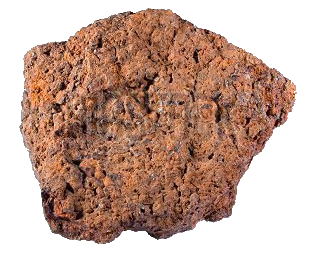
Bog iron was discovered during the pre-Roman iron age. Most Viking Iron was smelted from bog iron. In a bog, iron is concentrated by two processes. It is now rarely mined as more concentrated ore deposits are used as primary sources of iron ore. The first is chemical. In the acidic low oxygen environment of a bog, a chemical reaction forms insoluble iron compounds which precipitate out.   The second is Biological. This is due to, anaerobic bacteria (Gallionella and Leptothrix) growing under the surface. These excrete concentrate iron as part of their metabolism.   The presence of these bacteria can seen where there is an iridescent oily film on the bog water. ( In Iceland this is  called jarnbrak or iron slick).   When a layer of peat in the bog is cut back pea sized nodules of bog iron can be found and harvested. They are reasonably pure. As the process of iron production is ongoing the same section of bog can be harvested for iron about once every 40 years.   Iron made from bog ore will often contain some silicates. These form a glassy coating on the end product that helps prevent rusting.  

Bog Cotton


Bog cotton  is a species of sedge. It is often found on peat or acidic soils, in open bog, wetland, heath or moorland. It begins to flower in April or May and then develop distinctive white seed-heads that look like tufts of cotton. Bog cotton fibres are brittle and not suitable for textiles but they have been used as a substitute in the production of paper, pillows, candle wicks, and wound-dressings. The plant is edible and has a reputation for being effective in treating digestive problem.

Bog Turf Cutting


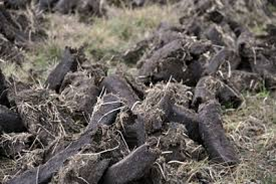
Turf remains an important fuel source in many areas of Ireland. Turf has traditionally been cut from the bog by hand, using a two-sided spade called a slean.  Today it is mainly cut using machines. Once cut the turf needs to dry as it is composed of 85% water and 15% vegetable material.  Turf looses up to 75% of its weight during the drying process. Drying involves turning each sod of turf to ensure the water is removed by the sun and wind.  Once partially dry the is then placed upright or  footed  (placing five or six sods of turf upright and leaning against each other ) to complete the drying.  When dry the turf is taken home and stored in ricks (a large stacked pile of Turf ) or in a shed.  The entire process takes from 4 to 12 weeks depending on the weather.

Bog Turf


There are four types of turf that have been used in Connemara. These are White Turf, Brown Turf, Rock Turf, Hand turf. White turf (spadach) is the top layer or a bog that when dried could be used as kindling as it had a high percentage of sphagnum moss. Brown turf was the next layer down and made good domestic fuel when dried. Rock Turf (Black Turf) was more compressed and when dried was used in forges and also as domestic fuel. Hand turf was formed by collecting and shaping the remains of broken turf or very wet turf off cuts. This was shaped by hand and then dried for domestic fuel.

Turf will usually only form where slope angles are less than 15° and at altitudes between 0 and 600 meters.  Throughout the centuries this valuable Connemara commodity fueled the early industries and provided fuel for heating and cooling. Turf has also been used as a feed stock to produce Charcoal, Gas, Naphtha and paper in other places but it is not known if it was used like this in Connemara. 

Turf Charcoal: In England peat was turned into charcoal by means of carbonisation. It is estimated that peat charcoal has the same calorific value as good coal with 100kg of dried peat yielding 36 Kg of charcoal. The charcoal was produced in kilns in which it was carbonise it into charcoal. A major draw-back to peat charcoal is that it is capable of holding a lot of water in proportion to its solid mass. It also takes up moisture quicker than it can lose it. This means there is a considerable amount of drying needed before it can be used. Once coal became more easily available it soon replaced peat charcoal.

Turf Gas. In Sheffield in the 19th it was found that, though the peat is found to contain gas the quantities were too low to be commercial. However one prison in Dartmouth used peat gas from local turf for lighting.

Turf Naphtha:  Peat has an average content of 65% volatile matter and when distilled it is possible to obtain naphtha oils. These can be used to produce candles, mothballs and gas for lighting.

Turf Paper: The fibrous top peat was also used to make paper in England. It was tried in Cornwall and the process consumed over 30 tons of peat a day. The venture lasted from 1846 to 1851.

Bog


Blanket bogs began to form in Ireland about 4,000 years as the climate changed and early settlers cut down the forests to make agricultural land. This allowed minerals to wash out of the top soil and form a hard iron layer underground. Water could not drain freely causing the soil to become waterlogged and acidic.  Dead plant material was preserved in the low oxygen, acidic environment and accumulates at an average rate of 1 MM per year. This overtime forms what is known as Peat (turf).   Peat is still harvested as an important source of fuel. This harvesting seems to have started in the 17th century as the last of the native forests were cleared and an alternative form of fuel was needed.  As a fuel turf has a higher carbon footprint (106 g CO2/ MJ) than coal (94.6 g CO2/MJ) or natural gas (94.6 g CO2/MJ).  Peat bogs had considerable ritual significance during the Bronze Age and Iron ages and peat wetlands formerly had a degree of metallurgical importance as well.  During the dark ages, peat bogs were the primary source of Bog Iron which is best known for its use in Viking arms and armour.