Showing posts with label Connemara Music. Show all posts

Music Bodhran


The bodhran is an Irish frame drum ranging from 25 to 65 cm (10   to 26  ) in diameter. It has only recently (1960s) entered into common use in traditional music.   There are no known references to this particular name for a drum prior to the 17th century. Various drums (played with either hands or sticks) have been used in Ireland since ancient times. The bodhran itself did not gain wide recognition as a legitimate musical instrument until the Irish traditional music resurgence in the 1960s in which it became known through the music of Sean o Riada and others.  It is generally constructed from a goatskin head tacked to one side of a circular wooden frame. (synthetic heads or other animal skins are sometimes used). The other side is open-ended for one hand to be placed against the inside of the drum head to control the pitch and timbre.  One or two crossbars, sometimes removable, may be inside the frame, but this is increasingly rare on modern instruments.

Music Bones or Spoons


The bones are a musical instrument (more specifically, a folk instrument) which, at the simplest, consists of a pair of animal bones, or pieces of wood or a similar material. Sections of large rib bones and lower leg bones are the most commonly used   Bones are typically about 5   to 7   (15 - 21 cm) in length, but can be much longer, and they are often curved, roughly resembling miniature barrel staves. Bones can also be flat, for example by the cutting of a yardstick. They are played by holding them between one s fingers, convex surfaces facing one another, and moving one s wrist in such a way that they knock against each other. A player may use a pair of bones in each hand, or just a single pair in one hand. The bones may be replaced by spoons which are played in the same manner.

Music Button accordions


Button accordions are widely used in Irish traditional music and are also popular in many countries where they are also used mainly for playing popular music and traditional folk music, and modern offshoots of these genres.   In Ireland, melodeon (Irish: mileoidean or an bosca) is reserved for instruments with a single row of melody buttons (a  one-row   instrument), while instruments with two or three rows are called button accordions (often simply accordions).

Music Concertina


A concertina is a free-reed musical instrument, like the various accordions and the harmonica. It has a bellows, and buttons typically on both ends of it.    The concertina was developed in England and Germany, most likely independently. The English version was invented in 1829 by Sir Charles Wheatstone, who filed a patent for an improved version in 1844. The English concertina is typically held by placing the thumbs through thumb straps and the little fingers on metal finger rests, leaving three fingers free for playing. Alternatively, both the fourth and little fingers support the metal finger rest, leaving two fingers for playing.

Music Celtic Harp


The Celtic harp is a triangular harp traditional to Brittany, Ireland, Scotland and Wales. In Ireland and Scotland it was a wire-strung instrument requiring great skill and long practice to play, and was associated with the Gaelic ruling class. In the Republic of Ireland, it appears on the coins and coat of arms.   A characteristic feature if the celtic harp is the metal strings. Historical sources mention various types of wire, including brass and iron. It has been suggested that gold and silver strings were sometimes also used. The wires are attached to a massive sound box typically carved from a single log, commonly of willow, although other woods including alder and poplar have been used in antique harps. This harp also had a reinforced curved pillar and a substantial neck, flanked with thick brass cheek bands. The strings, usually played with the fingernails, produced a brilliant ringing sound.

Music Fiddle


A fiddle is a bowed string musical instrument, most often called the violin. Fiddle refers to violins used to play folk music. Galway fiddling is slower than Sligo or Donegal traditions, with a heavier emphasis on ornamentation. Additionally, tunes are occasionally played in Eb or Bb to match the tonality of flat pipes.   Compared to classical violin, Irish fiddler tend to make little use of vibrato except for slow airs, and even then it is used relatively sparingly. Like the rest of Irish traditional music tradition, melodies are embellished through forms of ornamentation, such as rolls, trebles, and cuts.  Irish Folk music fiddling styles include:  Donegal fiddling from the northwest in Ulster, which features mazurkas and a Scottish-influenced repertoire including Strathspey and Highland Fling dances. Fiddlers tend to play fast and make heavy use of staccato bowing and may from time to time   play the bass,   meaning a second fiddler may play a melody an octave below where a first fiddler is playing it.  Sligo fiddling from northern Connacht, which like Donegal fiddling tends to be fast, but with a bouncier feel to the bowing.  Clare fiddling from northern Munster, which tends to be played near the slower Galway tempo yet with a greater emphasis on the melody itself rather than ornamentation.  Sliabh Luachra fiddling from the southwest in Munster, characterized by a unique repertoire of polkas and slides, as well as the use of double stops and drones as well as playing the melody in two octaves as in Donegal.

Music Irish flute


The vast majority of traditional Irish flute players use a wooden, simple-system flute. This is a conical-bore, simple-system wooden flute of the type favoured by classical flautists of the early 19th century, or to a flute of modern manufacture derived from this design (often with modifications to optimise its use in Irish Traditional Music.   The modern playing technique within  Irish Traditional Music has much in common with tin whistle technique. This involves using a number of ornaments to embellish the music, including cuts, strikes and rolls. Common ornaments and articulations include:  Cut and strike (or tap) Cut and strike   Cut   is rapidly lifting and putting down a finger;   Strike   is rapidly hitting and lifting an open hole with a finger.  Rolls A roll is a note with first a cut and then a strike. Alternatively, a roll can be considered as a group of notes of identical pitch and duration with different articulations.  Cranns Cranns (or crans) are ornaments borrowed from the Uilleann piping tradition. They are similar to rolls except that only cuts are used, not taps or strikes.

Music Tin Whistle


The tin whistle is a simple, six-holed woodwind instrument used widely in Irish traditional music. The modern tin whistle was first mass produced  by Robert Clarke from 1840?1882 in Manchester in the United Kingdom. Tin whistles gained popularity as a folk instrument in the early 19th century in the Celtic music revivals, tin whistles now play an integral part of several folk traditions in the  celtic nations.

Music Uilleann pipes


Uilleann pipes, Piobai uilleann (literally,   pipes of the elbow  ), from their method of inflation which is an elbow bellows   The uilleann pipes have a different harmonic structure, sounding sweeter and quieter than many other bagpipes, such as the Great Irish War pipes, Great Highland Bagpipes or the Italian Zampognas. The uilleann pipes are often played indoors, and are almost always played sitting down. The bag of the uilleann pipes is inflated by means of a small set of bellows strapped around the waist and the right arm (in the case of a right-handed player; in the case of a left-handed player the location and orientation of all components are reversed). The bellows not only relieve the player from the effort needed to blow into a bag to maintain pressure, they also allow relatively dry air to power the reeds, reducing the adverse effects of moisture on tuning and longevity. Some pipers can converse or sing while playing.

Music Ceilidh


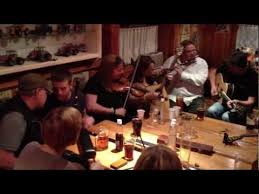
A ceilidh or ceilidh  is a traditional Irish social gathering, and can involve story telling  playing folk music and dancing.   Ceilidhs facilitated courting and prospects of marriage for young people and, although discos and nightclubs have displaced ceilidhs to a considerable extent. They can still  be an important and popular social outlet in rural parts of Ireland.  Ceilidh music may be provided by an assortment of fiddle, flute, tin whistle, accordion, bodhran, and in more recent times also drums, guitar and electric bass guitar.  In Ireland the first ceilidh band was put together in 1926 by Seamus Clandillon, Radio reran s director of Music, to have dance music for his studio-based programmes.  Dancing at ceilidhs is usually in the form of ceilidh dances, set dances or couple dances. A   Set   consists of six to eight couples, with each pair of couples facing another in a square or rectangular formation. Each couple exchanges position with the facing couple, and also facing couples exchange partners, while all the time keeping in step with the beat of the music.

Music Dord


The dord is a bronze horn native to Ireland, with excavated examples dating back as far as 1000 BC, during the Bronze Age. 104 original dords are known to exist, although replicas have been built since the late 20th century.   The musical tradition of the dord has been lost. It is believed that it was played in a manner similar to the Australian didgeridoo and apply that technique (including circular breathing and shifts in timbre) accordingly for modern fusion music. The Irish musician Simon O Dwyer recreates historically accurate dords.

Music Sean Nos


Sean-Nos singing is a highly ornamented style of solo, unaccompanied singing in Gaelic, confined mainly to a few areas in the west and south of the country. The Connemara style is a more decorated style, with forms familiar to a traditional instrumentalist along with other more complex forms.  It is unaccompanied and has a highly ornamented melodic form.   Sean-Nos songs can be relatively simple, though many are long, extremely stylised and melodically complex.  A good performance is highly individual and judged on its having substantial ornament and rhythmic variations from verse to verse. The performance of most songs are not restricted by gender. The lyrics can be changed to show whether it is a man or a woman singing or to represent their point of view. The interaction between the performer and audience is a crucial aspect of the sean-Nos singing tradition and some aspects of this interaction are almost ritualistic:  1) The singer may require encouragement to begin singing and is often part of the over all performance. 2) Some singers face a corner of the room away from the audience thought to be for acoustic benefits. 3) Audience participation is expected by words of encouragement and commentary or physical interaction with the singer. Such interaction does not disturb the flow of music, and the performer will often respond to it musically. The tradition of sean-Nos song was exclusively oral, and remains customarily so. However a few songs were known to have been conveyed to script as early as the 16th century. A songbook for Elizabeth the First?contained English interpretations of sean-Nos songs.  Songs started to be more extensively written down in the eighteenth century and distributed in print from then on. New composition is a controversial issue within sean-Nos song circles. Some singers insist that the traditional should be supplemented with new material, arguing that since society has changed, then the content of the lyrics should reflect this.  On the other hand, some singers say that only the older,   traditional   songs represent the essence of sean-Nos song and therefore deserve a protected, preferential status.

Dance Music


Irish traditional dance music was largely meant for dancing at celebrations for weddings, saint s days or other observances. Area style is  important to Irish traditional musicians. At the start of the last century, distinct variation in regional styles of performance existed. With increased communications and travel opportunities, regional styles have become more standardised. Soloists also create their own, unique, distinctive styles, often hybrids of  other influences the musician likes. Much of the local character of a Irish music style comes from the type of decoration that is added to a tune. Melody is very important in in Irish music. Harmony is kept simple and instruments are played in strict unison, always following the leading player. True counterpoint rare in Irish  traditional music, although a form of improvised counter melody is sometimes used.

Death Caoineadh Songs


These are songs which have lyrics which stress sorrow and pain. They are usually sung at funerals or other occasions of sorrow. Caoineadh singers were originally paid to lament for the departed at funerals. The Caoine or Caoineadh (keen) is the traditional mourning song practised in Gaelic speaking Ireland and Scotland. The Caoineadh is distinct from the more poetic and personalized mourning song, the Lament.  A Caoineadh is a ritualized wailing, generally starting high and descending in pitch, with words usually a repeated phrase such as Och Ochone (Woe, Woe) more spoken than sung.  The Caoineadh was traditionally sung by family members at the time of the loved ones death but later, as the body left the house for the last time, professional wailing women took up the Caoineadh.  Many Caoineadh have been lost as they were not recorded due to an unwillingness of the singers to sing them outside a mourning situation.

Death Caoin Importance


If a  caoine (mourning song)  has not been sung then the spirit of the dead person was damned and they would not rest in peace.

Music Caoine


If a  caoine (mourning song)  has not been sung then the spirit of the dead person was damned and they would not rest in peace.