Music Button accordions


Button accordions are widely used in Irish traditional music and are also popular in many countries where they are also used mainly for playing popular music and traditional folk music, and modern offshoots of these genres.   In Ireland, melodeon (Irish: mileoidean or an bosca) is reserved for instruments with a single row of melody buttons (a  one-row   instrument), while instruments with two or three rows are called button accordions (often simply accordions).

Music Concertina


A concertina is a free-reed musical instrument, like the various accordions and the harmonica. It has a bellows, and buttons typically on both ends of it.    The concertina was developed in England and Germany, most likely independently. The English version was invented in 1829 by Sir Charles Wheatstone, who filed a patent for an improved version in 1844. The English concertina is typically held by placing the thumbs through thumb straps and the little fingers on metal finger rests, leaving three fingers free for playing. Alternatively, both the fourth and little fingers support the metal finger rest, leaving two fingers for playing.

Music Celtic Harp


The Celtic harp is a triangular harp traditional to Brittany, Ireland, Scotland and Wales. In Ireland and Scotland it was a wire-strung instrument requiring great skill and long practice to play, and was associated with the Gaelic ruling class. In the Republic of Ireland, it appears on the coins and coat of arms.   A characteristic feature if the celtic harp is the metal strings. Historical sources mention various types of wire, including brass and iron. It has been suggested that gold and silver strings were sometimes also used. The wires are attached to a massive sound box typically carved from a single log, commonly of willow, although other woods including alder and poplar have been used in antique harps. This harp also had a reinforced curved pillar and a substantial neck, flanked with thick brass cheek bands. The strings, usually played with the fingernails, produced a brilliant ringing sound.

Music Fiddle


A fiddle is a bowed string musical instrument, most often called the violin. Fiddle refers to violins used to play folk music. Galway fiddling is slower than Sligo or Donegal traditions, with a heavier emphasis on ornamentation. Additionally, tunes are occasionally played in Eb or Bb to match the tonality of flat pipes.   Compared to classical violin, Irish fiddler tend to make little use of vibrato except for slow airs, and even then it is used relatively sparingly. Like the rest of Irish traditional music tradition, melodies are embellished through forms of ornamentation, such as rolls, trebles, and cuts.  Irish Folk music fiddling styles include:  Donegal fiddling from the northwest in Ulster, which features mazurkas and a Scottish-influenced repertoire including Strathspey and Highland Fling dances. Fiddlers tend to play fast and make heavy use of staccato bowing and may from time to time   play the bass,   meaning a second fiddler may play a melody an octave below where a first fiddler is playing it.  Sligo fiddling from northern Connacht, which like Donegal fiddling tends to be fast, but with a bouncier feel to the bowing.  Clare fiddling from northern Munster, which tends to be played near the slower Galway tempo yet with a greater emphasis on the melody itself rather than ornamentation.  Sliabh Luachra fiddling from the southwest in Munster, characterized by a unique repertoire of polkas and slides, as well as the use of double stops and drones as well as playing the melody in two octaves as in Donegal.

Music Irish flute


The vast majority of traditional Irish flute players use a wooden, simple-system flute. This is a conical-bore, simple-system wooden flute of the type favoured by classical flautists of the early 19th century, or to a flute of modern manufacture derived from this design (often with modifications to optimise its use in Irish Traditional Music.   The modern playing technique within  Irish Traditional Music has much in common with tin whistle technique. This involves using a number of ornaments to embellish the music, including cuts, strikes and rolls. Common ornaments and articulations include:  Cut and strike (or tap) Cut and strike   Cut   is rapidly lifting and putting down a finger;   Strike   is rapidly hitting and lifting an open hole with a finger.  Rolls A roll is a note with first a cut and then a strike. Alternatively, a roll can be considered as a group of notes of identical pitch and duration with different articulations.  Cranns Cranns (or crans) are ornaments borrowed from the Uilleann piping tradition. They are similar to rolls except that only cuts are used, not taps or strikes.

Music Tin Whistle


The tin whistle is a simple, six-holed woodwind instrument used widely in Irish traditional music. The modern tin whistle was first mass produced  by Robert Clarke from 1840?1882 in Manchester in the United Kingdom. Tin whistles gained popularity as a folk instrument in the early 19th century in the Celtic music revivals, tin whistles now play an integral part of several folk traditions in the  celtic nations.

Music Uilleann pipes


Uilleann pipes, Piobai uilleann (literally,   pipes of the elbow  ), from their method of inflation which is an elbow bellows   The uilleann pipes have a different harmonic structure, sounding sweeter and quieter than many other bagpipes, such as the Great Irish War pipes, Great Highland Bagpipes or the Italian Zampognas. The uilleann pipes are often played indoors, and are almost always played sitting down. The bag of the uilleann pipes is inflated by means of a small set of bellows strapped around the waist and the right arm (in the case of a right-handed player; in the case of a left-handed player the location and orientation of all components are reversed). The bellows not only relieve the player from the effort needed to blow into a bag to maintain pressure, they also allow relatively dry air to power the reeds, reducing the adverse effects of moisture on tuning and longevity. Some pipers can converse or sing while playing.

Music Ceilidh


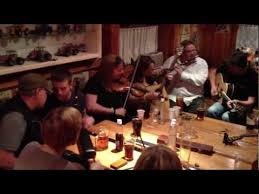
A ceilidh or ceilidh  is a traditional Irish social gathering, and can involve story telling  playing folk music and dancing.   Ceilidhs facilitated courting and prospects of marriage for young people and, although discos and nightclubs have displaced ceilidhs to a considerable extent. They can still  be an important and popular social outlet in rural parts of Ireland.  Ceilidh music may be provided by an assortment of fiddle, flute, tin whistle, accordion, bodhran, and in more recent times also drums, guitar and electric bass guitar.  In Ireland the first ceilidh band was put together in 1926 by Seamus Clandillon, Radio reran s director of Music, to have dance music for his studio-based programmes.  Dancing at ceilidhs is usually in the form of ceilidh dances, set dances or couple dances. A   Set   consists of six to eight couples, with each pair of couples facing another in a square or rectangular formation. Each couple exchanges position with the facing couple, and also facing couples exchange partners, while all the time keeping in step with the beat of the music.

Music Dord


The dord is a bronze horn native to Ireland, with excavated examples dating back as far as 1000 BC, during the Bronze Age. 104 original dords are known to exist, although replicas have been built since the late 20th century.   The musical tradition of the dord has been lost. It is believed that it was played in a manner similar to the Australian didgeridoo and apply that technique (including circular breathing and shifts in timbre) accordingly for modern fusion music. The Irish musician Simon O Dwyer recreates historically accurate dords.

Music Sean Nos


Sean-Nos singing is a highly ornamented style of solo, unaccompanied singing in Gaelic, confined mainly to a few areas in the west and south of the country. The Connemara style is a more decorated style, with forms familiar to a traditional instrumentalist along with other more complex forms.  It is unaccompanied and has a highly ornamented melodic form.   Sean-Nos songs can be relatively simple, though many are long, extremely stylised and melodically complex.  A good performance is highly individual and judged on its having substantial ornament and rhythmic variations from verse to verse. The performance of most songs are not restricted by gender. The lyrics can be changed to show whether it is a man or a woman singing or to represent their point of view. The interaction between the performer and audience is a crucial aspect of the sean-Nos singing tradition and some aspects of this interaction are almost ritualistic:  1) The singer may require encouragement to begin singing and is often part of the over all performance. 2) Some singers face a corner of the room away from the audience thought to be for acoustic benefits. 3) Audience participation is expected by words of encouragement and commentary or physical interaction with the singer. Such interaction does not disturb the flow of music, and the performer will often respond to it musically. The tradition of sean-Nos song was exclusively oral, and remains customarily so. However a few songs were known to have been conveyed to script as early as the 16th century. A songbook for Elizabeth the First?contained English interpretations of sean-Nos songs.  Songs started to be more extensively written down in the eighteenth century and distributed in print from then on. New composition is a controversial issue within sean-Nos song circles. Some singers insist that the traditional should be supplemented with new material, arguing that since society has changed, then the content of the lyrics should reflect this.  On the other hand, some singers say that only the older,   traditional   songs represent the essence of sean-Nos song and therefore deserve a protected, preferential status.

Dance Music


Irish traditional dance music was largely meant for dancing at celebrations for weddings, saint s days or other observances. Area style is  important to Irish traditional musicians. At the start of the last century, distinct variation in regional styles of performance existed. With increased communications and travel opportunities, regional styles have become more standardised. Soloists also create their own, unique, distinctive styles, often hybrids of  other influences the musician likes. Much of the local character of a Irish music style comes from the type of decoration that is added to a tune. Melody is very important in in Irish music. Harmony is kept simple and instruments are played in strict unison, always following the leading player. True counterpoint rare in Irish  traditional music, although a form of improvised counter melody is sometimes used.

Dance Dress


The dress used for Irish dancing in competitions is usually that men wear a white shirt, vest and black trousers. Women wear decorated dresses (usually embroidered with celtic designs). In the past the appropriate dress for a competition or social dancing  was simply Sunday best (clothes one would wear to church). Irish Dance schools generally have school dresses, worn by lower-level competitors and in public performances. As dancers advance in competition or are given starring roles in public performances, they may get a solo dress of their own design and colours. In the 1970s and 1980s, ornately embroidered dresses became popular.

Dance Shoes


There are two types of shoes; soft shoes (also known as ghillies) and hard shoes. The first hard shoes had wooden or leather taps with metal nails. Hard shoes are similar to tap shoes, except that the tips and heels are now made of fibre glass, instead of metal. They are  also bulkier than tap shoes. The soft shoes, which are called ghillies, are black lace-up shoes. Ghillies are only worn by girls, while boys wear black leather shoes called reel shoes, which resemble black jazz shoes with a hard heel. Boys soft-shoe dancing features audible heel clicks.

Dancing Set Dancing


Set dancing is sometimes called country sets. They are a popular form of folk dancing in Ireland. Set dances are based on quadrilles. The latter were court dances which were transformed by the Irish into a unique folk dance of the Irish rural communities. Distinctive set dances and dance regions emerged in the beginning of the 19th century and evolved as popular house dances separate from the more formal Irish step-dancing tradition. Set dancing was promoted during the 1930s and 1940s . The rise of rock and roll in the 1950s caused a fall in the popularity of set dancing. In the 1980s set dancing enjoyed a revival and many forgotten sets were revived. Set dances from a particular region usually have similar elements. For instance, sets from the Connemara region (such as the Connemara Reel Set, the South Galway Reel Set and the Claddagh Set). Four couples are arranged in the form of a square to dance with each couple being in the middle of the sides of the square. Both the eight dancers in the group and the dance itself are called a   set. The dance is a sequence of several dance figures, which usually have a common theme or structure. The figures usually begin and end with repeated parts that everyone dances, and then during the figure each couple or pair of couples will dance separately.

Dance Sean Nos


Sean Nos in Irish Gaelic means   old style  , and is applied to the dance form as well as Sean-Nos song. It is an older form of traditional solo Irish dance. It is a casual dance form, as opposed to the more formal competition-oriented form, of Irish step dance. The roots of this form of dancing pre-date modern records. Differences in Sean-Nos dance between different regions of Ireland exist. Often it is attributed to the Connemara region, due to its stronger following here. There is no singular definitive standard of Sean -Nos. In the past every region had its own style which was influenced over time. Notable events in Irish history can be seen through the dance, like the steps of Ulster influenced by Scottish dancing and the low steps of the west coast influenced by the Spanish flamenco. Sean-Nos dance is characterised by its   low to the ground   footwork, improvised steps, free movement of the arms, and an emphasis upon a   battering step   (which sounds out more loudly the accented beat of the music). Traditional Sean-Nos dance surfaces include a standard wooden dance floor, a door that has been taken off the hinges, a table, a barrel, or even the top of a stool. In those cases, the skill of the dancer is shown by how well s/he can produce the various steps within the narrow bounds of the dance surface. By its nature, it follows the music closely. It is traditionally a solo dance form. Because Sean-Nos dancing is improvisational, it is not necessary for a pre-arranged routine or choreography to be decided upon by the dancer. Spontaneous expression is highly valued. Therefore, it is less common to see groups performing synchronised Sean-Nos dance (which requires choreography in advance). Instead, the dancers may dance in turns, playing off the energy of the other.

Dance Reel


The reel is a folk dance type as well as the accompanying dance tune type. In Irish dance, a reel is any dance danced to music in reel time. Reel music is  simple in meter, either as 2/2 or 4/4. The reel is danced in soft shoes. All reels have the same structure, consisting largely of quaver (eighth note) movement with an accent on the first and third beats of the bar. A reel is distinguished from a hornpipe by consisting primarily of even beats. Today many Irish reels are supplemented with new compositions and by tunes from other traditions which are easily adapted as reels. It is the most popular tune-type within the Irish dance music tradition.

Dance Hornpipe


The hornpipe is an Irish, Scottish and English dance. It is danced in hard shoes, which are used to help keep track of how the dancer keeps in time. There are two variations of the hornpipe dance: fast and slow. Usually, more experienced dancers will do the slow hornpipe but younger dancers will start out with the fast hornpipe and then switch in later years. There is a change of tempo in the music but not the dancing between these two speeds. The only difference in the dancing between the fast and slow steps are the dances that the dancer does and the rhythm/sound of how they move their legs. The rhythm for both fast and slow hornpipes is very even and should be executed that way by the dancer.

Dry Stone Walls


Connemara dry stone walls are built by carefully selecting stones that will balance and sit into the wall. No mortar or cement is used in their construction. Field or enclosures needing a stone wall are generally cleared of surface stone and rocks that are then used in the construction of the dry stone walls. This serves the dual purpose of making the land more usable and providing free materials for boundary walls.   The Ceide Fields in Mayo show how the construction of dry stone walls has changed little in over 5000 years.   Dry stone walls are generally quite low and require regular maintenance to replace fallen stones. In some places gates are not made in the walls and an access is made in a wall when needed and then rebuilt. Most traditional dry stone walls to not have a cap layer (the top layer). Cap layers tend to stabilise the wall.   The walls are constructed with little or no foundation. The largest stones are placed at the bottom and increasingly smaller, carefully selected stones are added as the wall rises in height.   Stones are not worked to ensure the best fit. Stones are however often split where a specific shape stone is needed.  In the time of the Famine (1845 to 1847) building walls was used as a means of providing income to starving families. These walls can be up to 35 km in length and often serve no purpose as a boundary for fields or farms.

Dewberry


The dewberries are a group of species in the genus Rubus, section Rubus, closely related to the blackberries.  Unlike Blackberries they have separate male and female plants. Dewberries are common throughout most of Connemara and are mainly in dry grassland, hedgerows and in sandy places.     The fruits of this plant are edible.  The berries are sweet and edible. They can be eaten raw, or used to make cobbler, jam, or pie.  The blackberry-like fruits have less drupes or individual segments than those of Bramble but each segment is larger than on that plant.  They also have a blue-silver bloom like that on the Sloes of the Blackthorn plant.

Derrylea Lough Creature 1961


The sighting in 1961 was of a black eel like creature 3 - 4 metres in length. It remained in view for over half an hour. Local legends speak of a "Horse Eel " creature living in the lakes and capable of moving overland between them.

Derrylea Lough Creature 1888


In the late 1880s, during a drought, a  second creature similar to the one at Ballynahinch became lodged and died in a culvert between Derrylea and Gowlan lakes.

Death Caoineadh Songs


These are songs which have lyrics which stress sorrow and pain. They are usually sung at funerals or other occasions of sorrow. Caoineadh singers were originally paid to lament for the departed at funerals. The Caoine or Caoineadh (keen) is the traditional mourning song practised in Gaelic speaking Ireland and Scotland. The Caoineadh is distinct from the more poetic and personalized mourning song, the Lament.  A Caoineadh is a ritualized wailing, generally starting high and descending in pitch, with words usually a repeated phrase such as Och Ochone (Woe, Woe) more spoken than sung.  The Caoineadh was traditionally sung by family members at the time of the loved ones death but later, as the body left the house for the last time, professional wailing women took up the Caoineadh.  Many Caoineadh have been lost as they were not recorded due to an unwillingness of the singers to sing them outside a mourning situation.

Death Caoin Importance


If a  caoine (mourning song)  has not been sung then the spirit of the dead person was damned and they would not rest in peace.

Music Caoine


If a  caoine (mourning song)  has not been sung then the spirit of the dead person was damned and they would not rest in peace.

Cuviers beaked whale


They may occur in numbers over the Atlantic continental shelf - most records Jan to March and June to September.  One was washed up (dead) on Clifden beach on December 24 2014. Key Identification Features: Max body length: 23 ft, Average body length: 20 ft, Blow: Slightly forward and to left, inconspicuous. Head: Gently sloping forehead. Beak: Indistinct (less distinct with age). Dorsal Fin: Small, falcate. Colouration: White, beige to brown. Colour varies according to location, sex or age. Older animals almost white. Markings: Upper side can be almost white in front of dorsal fin. Swirling patterns typical of many animals. White or cream on underside and sides. Often leave marks from teeth. Field Identification: The dorsal fin is often the first feature seen at sea and is set far back on the body. The head is usually small and pale, visible only when sighted close up when the animal is surfacing from a deep dive or surfacing to breath before deep diving, when they may also steeply arch back and lift flukes. Colour variations are common, light brown to grey or white in older animals. Behaviour: Although rarely seen, these whales have been known to breach and occasionally approach boats. Food and Feeding: Cuvier  s are a deep diving animal. It is thought they feed primarily on squid. Social Structure: Although information is very scarce it is thought that Cuviers beaked whales live in family groups of up to 25 individuals. A typical group size would be 5  to  7. Single animals are thought to be old males. Where and When Best Seen in Ireland: Although rarely seen alive, they are the most frequently recorded beaked whales in Ireland. Between 1901  to  1995, 21 individuals washed up along our coast, an average of just 1 every 4 years. In 1997, two were recorded. But in nine days in March 2000, three washed up dead on Irish beaches, two in Co. Clare and one in Co. Sligo. Then on May 1st 2000 a fourth washed up at Ballyferriter, Co. Kerry. The IWDG raised the possibilities of these unusual stranding events being linked to offshore seismic surveys along the west coast. They may occur in numbers over the Atlantic continental shelf - most records Jan to March and June to September. Species Similar in Appearance: The beaked whales are among the most difficult to tell apart, thus the cuvier  s can easily be confused with almost any other beaked whale, and perhaps the bottlenose whale and minke whale. Status and Distribution:  is known mainly form strandings and a few sightings. Cuvier  s beaked whale appears to be one of the most abundant and widespread of the beaked whales. It has a very broad range in the Atlantic, Pacific and Indian Oceans, but is apparently absent from Polar waters. It is encountered around oceanic volcanic islands with some regularity. Reproduction and Life Cycle: Too little is known about their life history to comment.

Cuckoo


The best time to hear a cuckoo is during most evenings between mid-April and June. It is summer migrant from Africa the Cuckoo is a brood Parasite (lays eggs in other birds nests). The cuckoo s favoured foster parent species include pipits, warblers, dunnocks and robins. The cuckoo is now a protected bird but populations continue to decrease due to loss of habitat and the use of insecticides.  The male cuckoo is famous for its   distinctive koo-kooO  call. Females have a bubbly chuckle sound different from the males.  Juvenile cuckoos migrate several weeks later than their real parents, and they manage to find their way to the regular wintering areas despite never having made the journey before.  Cuckoos feed on the ground, but are clumsy walkers. They can often be seen perched on telegraph lines.  The cuckoo has long been associated with fate for humans. Numerous beliefs exist, including: it is good luck to have money in your pocket when you hear a cuckoo; whatever you are doing when you hear a cuckoo, you should repeat throughout the year as the call was a sign that the particular activity will be beneficial; for single people, the number of calls or notes would signify how many years they would remain unmarried; and in Sweden, the direction of the call signifies either good luck (west), death (south), consolation (east), or sorrow (north).

Crannog


A crannog is usually a partially or entirely artificial island, usually built in lakes, rivers and estuarine waters of Ireland. Crannogs were built in the water, as artificial islands for security and protection.   They were used as dwellings over 5000 years, from the Neolithic Period to as late as the 17th or early 18th century. Crannogs have been constructed as free-standing wooden structures, or more commonly as brush, stone or timber mounds reinforced with timber piles. They often had an hidden underwater path to access them. In Connemara completely stone crannogs supporting drystone architecture are common. Crannogs can be seen as small, circular islets, often 10 to 30 metres (30 to 100 ft) in diameter, covered in dense vegetation and trees.

Corrib Prehistoric Boat


A 4500 year old dug out boat was found at the bottom of Lough Corrib in 2012. The boat is made from a 16m section of oak and is 1.5m wide. It is the longest boat and one of the oldest of its type ever found in Europe. Dug out boats of this type got shorter over the centuries as the larger trees were cut down.   The interior of the boat is carved and sanded smooth.  It lies, well preserved, under 5 cm of silt and was examined by the Underwater Archaeology Unit in the late summer 2013. Other boats of a similar type have also been found in Lough Corrib.

Coral ( Maerl) Beaches


Maerl is a name for a group of red seaweeds (Lithothamnion corallioides, Lithothamnion glaciale and Phymatolithon calcareum) that deposit calcite in their cell wall. When sections break off these seaweeds the bits form (in certain locations) coral beaches. There are two known coral beaches in Connemara at Ballyconneely and one at Carraroe. These  gravel beaches a rare and of great conservation importance. The Coral Strand and Tran an Doilin are unusual beaches formed from the dead fragments of "maerl", a twig-like calcareous seaweed (Lithothamnion spp.).  This seaweed, which is pinkish- purple when alive, changes to a bright golden-yellow once it dies. This type of beach material is washed up at only a few locations in Ireland - including Tran an Doilin, Carraroe and the Coral Strand Ballyconneely.    Maerl beds are found up to 30 m down in Irish waters and can be up to 10 m thick.   Radio carbon dating has found the lowest layers to be over 5000 years old.  Maerl beds are slow to regenerate (1 mm per year). Beds of Maerl are ecologically important. They are a nursery for the juvenile stages of commercial species such as cod,  Pollack and scallops. Maerl beds are easily damaged by dredging and towed fishing gear. It is illegal in Ireland to remove maerl from beaches.  This substance was extensively dredged as a source of lime for gardens and organic farms. This is because it contains high concentrations of calcium and magnesium. ( 32.1% CaCO3 and 3.1% MgCO3 ).

Connemara Salvage Operation 1834

The Connemara Expedition: In 1834 a salvage operation was launched to recover items from up to 11 ships that had recently floundered on the Connemara Coast during storms. Reports were published of a diving expedition to the Connemara area, west of Galway, in July of 1834, but the promoters are unnamed and the expedition was obstructed by the authorities. The Connemara Expedition:  The Sarah, of Pwlheli, was lately fitted up with a diving-bell and suitable apparatus for the purpose of raising 11 vessels wrecked close to the Galway shore during the last severe winter, amongst which are understood to be the Thais, Falmouth packet; the Whitbread of London, the James of Tynemouth, the Rival of Glasgow, which had Don Pedros troops on board.  Along with a Philadelphia ship, a sloop from Scotland and a revenue cutter. These vessels are much in the way of fishing nets. The coastguard of Inishlackan seized the Sarah as she lay in ballast in Roundstone harbour ready to go to work and forbade any further work relating to raising the wrecks in the name of Admiralty.

Connemara Pony


The Connemara Pony is Irelands only native breed.   The pony is bred on all continents - except Antarctica.   Legend says that Andalusian horses came from the wrecks of Spanish Armada ships and bred with the native Connemara horses.  History: In the early 5th century B.C., the Connemara resembled a Shetland pony.  Celtic raiders then bred the horses to the Spanish Jennet and the Irish Hobby (an extinct breed of horse - native to Ireland).  Extensive crossbreeding eventually began to dilute the bloodlines .  However, in 1923 the Connemara Pony Breeders   Society was founded to preserve the breed type. The stud book was established in 1926.  There are over 2,500 web sites dedicated to the breed across the world.

Connemara Name


The name Connemara comes from the Conmaicne Mara tribe who were found on the western seaboard of County Galway. The Conmaicne were of the older tribes of Connacht. Their lineage is claimed from Conmac, a descendant of Queen Medhbh and Fergus MacRoigh.  

Connemara Marble


Connemara marble is over 600 million years old. It is only found in Connemara. It has been a traded item since prehistoric  times as is evident from a carved green marble spearhead dating from 2000 years ago which was excavated in Suffolk in the United kingdom. Dating from the Pre-Cambrian era, Connemara marble is a metamorphic rock formed when limestone was heated under pressure, producing a hard granular rock.  The Connemara metamorphic complex, of which the marbles are part, is part of a belt of rocks extending from the Appalachian Mountains, through Ireland, Scotland and into Norway.  Connemara marble has a unique green colour, and its distinctive swirling veins of  green, sepia and grey with the added sparkle of crystalline mica.   It has the following chemical components: 60%  Dolomite (CA, Mg(CO3)2)  36%  Mica and serpentine (Mg3Si2(OH)4) 02%  Calcite (CACO3)    It has been a traded item since prehistoric  times as is evident from a carved green marble spearhead dating from 2000 years ago which was excavated in Suffolk in the United kingdom. Today it is a valuable export from Connemara.   It is available in large dimensional slabs suitable for buildings as well as for smaller pieces of jewellery.   It is used for the pendant for the Scouting Ireland Chief Scout s Award, the highest award in Irish Scouting.  In 1903, King Edward VII and Queen Alexandra visited a Connemara Marble quarry during the Royal Tour of Connemara.   Today, the marble of Connemara can be found in the world s great monuments. In the halls of Trinity College Dublin, on the Victoria and Albert Museum in London, in Kensington Palace and in some of America s finest buildings.  

Connemara Fishing Industry


Fishing has been an important part of the Connemara Economy for thousands of years. Its importance on the island of Inishbofin, Connemara, is used to illustrate this. The large numbers and the size of the middens found along the Connemara coast show that its early hunter gatherer inhabitants included large amounts of shellfish and sea fish as a  major part of their diet. Recent archaeological research has also identified a growing number of fish traps that were used to channels fish so that they could be caught more easily. Some of these have been provisionally estimated to be over 5,000 years old.  As the population become more settled and communities formed the methods used for fishing changed as did its relative importance to the population. Inishbofin provides a good example of the types of fishing and the methods used in many parts of Connemara between the 18th and 21st centuries.  The importance of fishing on Inishbofin has varied considerably during the last centuries. The harbour on Inishbofin was historically used for shelter by fishermen from other ports in Ireland and Europe. These were attracted by the rich fishing grounds close to Inishbofin. Currently fishing on Inishbofin is at a low level when compared to the fishing in the past. The main activity today is lobster and crab potting. During the summer season some sea angling is also carried using local boats. They are also used to transport visiting scuba divers. In the past on Inishbofin, as in most places in Connemara, most fishermen were also involved in farming. Fishing was an extra means of earning money, whilst agriculture provided most of the food for Inishbofin families. The cost of purchasing nets and other fishing gear were high and where farmers were in arrears with their rent they were often impounded until the rent was paid up to date. The landlords of Inishbofin insisted that the fishing gear used by the islanders was bought from them and that they bought much of the fish. This allowed them to charge more for the equipment and less for the fish than on the mainland. The boats used on Inishbofin were much the same as used elsewhere in Connemara. The only exception was the use of a larger rowing boat crewed by up to 6 rowers. These also had a sail.  Curraghs and puchauns were also used. Puchauns were traditionally used for drift netting for herring and Mackerel. There were some hookers. These were used mainly for transport rather than fishing on Inishbofin.  Two additional types of boat were introduced to Inishbofin in the 19th century by the Congested Districts Board. These were the Nobby which is an inshore sailing boat used as a traditional fishing boat around Cornwall, Lancashire and the Isle of Man and the Zulu which was a Scottish design with a length of  52 feet (16 m) and a 39-foot keel length (12 m). There were up to 100 nobbys at Inishbofin. Both types of boat were used for drift netting until around 1926 when the salted fish industry went into decline. This eventually led to the end of the curing and barrelling of mackerel and herring on Inishbofin.   Fish were salted in barrels which were kept in the houses. The salt content of the brine was measured by seeing if a  mackerel or potato would float in it. In the 1960 s BIM developed inshore trawling and up to 4 medium sized trawlers were based in Inishbofin.  The main fishing methods used around Inishbofin include lobster potting, long- and hand lining, drift netting, seine netting trawling, gill and trammel netting. Lobster fishing which began in the 18th century was carried out using currachs and puchauns. Half deckers became important during the 1970 s, mostly fishing for lobsters and crayfish but the use of trammel nets during this time has been for the virtual disappearance of crayfish from the water around Inishbofin. Some lobster and crab fishing is still carried out from the island. Lobsters were sold by the   baker s dozen  , or per 13 lobsters, not being sold by weight until the 1950 s. Crabs are an important catch around Inishbofin. The large sub-tidal edible crab is caught in lobster pots along with lobsters. Generally only the crab claws are marketable. The claws are taken off the crab and the crab is returned to the sea. As the crab is capable of re-growing a claw, some fishermen only take one claw off. Growing demand for crab claws has meant that both claws are often removed. Whether the crab can survive without at least one claw is not known. Herring stocks have virtually disappeared since the 1970s and overall fish stocks are depleted. Mackerel are also fewer and of a far smaller size than was common in the past. Basking sharks were also reported near Inishbofin and some sightings have been made in recent years. These were not fished by locals but were fished by visiting Norwegian boats for liver oils. Whale meat was eaten on the island in the early 1800  but there is no record of what hunting on the Island. Seaweed has always been important on Inishbofin. It has been used as a fertiliser and burned for its iodine content. Both of these activities have virtually ceased in recent decades. Seaweed harvesting and Lobster / crab fishing had territories that were understood by the fishermen from the island fishing areas and fishermen from other islands. Various (legal and not so legal) methods of enforcement were used to maintain the integrity of the boundaries and prevent encroachments.  Fatalities at sea have always been a part of fishing life on Inishbofin. Storms, over loaded boats and poor navigation have been causes of marine deaths off Inishbofin. One lady who lived on Inishbofin during the late 19th century and early 20th century, lost two husbands and two sons in three different drowning accidents. The Cleggan Disaster, which occurred on the night of Friday 28th October, 1927 cost the lives of nine fishermen from Inishbofin, as well as 44 from other fishing communities. Only one body of the Inishbofin fishermen was ever recovered. This disaster affected many families on the island, and marked the end of the gill net fishery for herring and mackerel on the island.

Connemara Black Faced Sheep


The Connemara Black face sheep is a particular breed type that evolved and adapted over centuries to survive the harsh conditions on the mountains of Connemara and west Mayo. It is believed they originate from the wild, horned Argali sheep that inhabited central Asia in ancient times.  Thousands of Black face sheep were imported from Scotland through the Killary Harbour during the 1850  s and the black face sheep of the Connemara/Mayo area are probably descended from this original importation.  They have the necessary resilience for the rugged terrain of Connemara.  Their wool is very coarse in texture making it more suited to carpet manufacture.   Their mountain habitat and diet produces a very lean, sweet tasting meat .

Common Skate


The  common skate  or  blue skate  (Dipturus batis) is the largest  skate  in the world attaining a length of more than 250  cm and weigh  up to 220  lb (100  kg. it has been listed as Critically Endangered globally in 2006 by the UN. It is threatened both in the Atlantic Ocean and Mediterranean Sea. In both areas, it seems likely due to fishing trawls that are after things like hake or anglerfish, and who simply catch the Common Skate by accident. Common Skate around 11 years to reach sexual maturity. Once it has reached sexual maturity, they will only reproduce every other year.   They mate in the spring and during the summer they lay approximately 40 egg cases which they put in sandy/muddy flats. The embryos then develop for 2 to 5 months before leaving their egg case.  Egg cases are measured up to 25  cm long (excluding the horns) and 15  cm wide.   In the 19th and 20th centuries egg cases were usually seen along the entire British coastline in high numbers, but now they are only found in a few selective areas.

Common Seal


The  Common , or Harbour seal, as it is also known, is mainly an inshore animal, frequenting inlets, estuaries and unpolluted harbours. This seal is less numerous than the Grey seal over much of the western and northern coastlines. Population: 2003 estimate seal census 2,900 in Ireland The  Common , or Harbour seal, as it is also known, is mainly an inshore animal, frequenting inlets, estuaries and unpolluted harbours. This seal is less numerous than the Grey seal over much of the western and northern coastlines. It is the smaller of the two Irish seal species. Females are smaller than males. Bulls may reach 6ft (2m) long and weigh 550lb (250kg. Females reach 5ft and weigh 330lb (150kg).  Pups are born on land but can swim straight away. Coat colour is variable but usually some shade of grey or white with darker spots. . The adult has predominantly greyish to greyish-brown upper parts, with irregular black mottling. This mottling is repeated on the underside, which is lighter, silver or cream. The young have a darker, greyish brown mottled coat. The common seal favours shallow, sheltered coastal waters and estuaries. It can dive for up to 10 minutes and eats a wide variety of inshore and estuarine fish species.

Common Newt


The common newt is found all across Ireland where there is suitable habitat is found. They favour ponds and shallow lake sides. The smooth newt is the only newt native to Ireland, and it is protected there under the Wildlife Acts (1976 and 2000). It is an offence to capture or kill a newt in Ireland without a licence. Both sexes are of similar size (roughly 10 cm head-to-tail length), and a similar pale brown to yellow colour.  Adult smooth newts emerge from hibernation on land from late February to May, and head towards fresh water to breed.   At this time, both sexes become more strikingly and colourfully marked, with vivid spots and orange bellies. The male also develops a wavy crest along the back and tail  to  the sexes are clearly different during the breeding season.  Once fertilised, after a few days the female starts to lay eggs. These are placed individually, usually under aquatic plant leaves at a rate of seven to 12 eggs per day. Altogether, a total of 400 eggs may be produced over the season.  After two to three weeks (depending on water temperature), the eggs hatch to a larval form  to  a tadpole or eft.   As the tadpoles mature, they develop legs (front first), and the growth and use of their lungs is matched by a gradual shrinkage of the gills. Over 10 weeks the larva gradually shift from being fully aquatic to having a body suitable for living on land. (Some may over winter in the larval state, only emerging from the water the following year).

Common Lizard


The common lizard is Irelands only reptile. occurs in drier environments, including open woodland, meadows, moorland, heath land, fens, dunes, rocks, roadsides, hedgerows and gardens. It lives mainly on the ground, although it may climb onto rocks, logs and low-growing vegetation. The length of the lizards body is less than 12 cm (5 in) (excluding the tail). The tail is up to twice as long as the body, although it is often partially or wholly lost. The limbs are short, and the head is rather round. Males have more slender bodies than females. The neck and the tail are thick.   The main colour is typically medium brown, but it can be also grey, olive brown or black.   Females may have dark stripes on their flanks and down the middle of their backs. Sometimes females also have light-coloured stripes, or dark and light spots along the sides of their backs. Most males and some females have dark spots in their undersides. Males have brightly coloured undersides  to  typically yellow or orange, but more rarely red. Females have paler, whitish under parts. The throat is white, sometimes blue.  In early spring, late autumn, and cool summer days, it basks in the sun to reach its optimum body temperature, which is about 30 °C (86 °F).  Lizards feed on invertebrates, mostly small insects.   Males reach sexual maturity at two years old, females at three years old.  Lizards mate in April or May. Males take females in their jaws before mating  to  if the female is not interested, she will bite the male fiercely. The offspring develop for about three months inside the female.   Lizards give birth to live young, an adaptation to a cool climate, but some southern populations lay eggs. The three to 10 young (or eggs) are usually produced in July.   In Ireland lizards begin hibernation in September or October usually underground or in log piles. Hibernation ends about mid-February.  

Common Frog


The common European frog was thought to have been introduced to Ireland but is now deemed to be a native species due to genetic analysis. Ireland is the most westerly part of its range. Common frogs have a three stage life cycle  ” aquatic larva, terrestrial juvenile, and adult.   They have fat bodies with a rounded snout, webbed feet and long hind legs adapted for swimming in water and hopping on land.  Adult common frogs have a body length of 6 to 9 centimetres (2.4 to 3.5 in).  Their backs and flanks vary in colour from olive green to grey-brown, brown, olive brown, grey, yellowish and rufous. Both black and red individuals have been found and albino frogs have been seen with yellow skin and red eyes.  Common frogs are known to be able to lighten and darken their skin in order to match their surroundings.  Newly hatched tadpoles are mainly plant eating. They  feed on algae, detritus, plants and some small invertebrates. They become fully carnivorous once their back legs develop and feed on small water animals or even other tadpoles when food is scarce.  Juvenile frogs feed on invertebrates both on land and in water.   Adults only feed on land. Common  frogs eat mainly insects (especially flies), snails, slugs and worms. They feed on any invertebrate of a suitable size, catching their prey on their long, sticky tongues. They do not feed during the short breeding season. Common  frogs eat mainly insects (especially flies), snails, slugs and worms.  Outside the breeding season, common frogs live a alone in damp places near ponds or marshes or in long grass. They are normally active for much of the year, only hibernating in the coldest months.  Common frogs breed in shallow, still, fresh water such as ponds, with spawning commencing sometime between March an late June, but generally in April .  Tadpoles are eaten by fish, beetles, dragonfly larvae and birds. Adult frogs have many predators including storks, birds of prey, crows, gulls, ducks, terns, herons, pine martens, stoats, weasels, polecats, badgers and otters. Some frogs are killed, but rarely eaten, by domestic cats, and large numbers are killed on the roads by motor vehicles.

Common Dolphin


They are frequently observed in shallow inshore waters off the south and southwest coasts and around the Aran Islands but also frequently seen in the southern Irish Sea and offshore. Key Identification Features:  Maximum body length: Adult male: 2.6m, adult female 2.3. Average body length: Adult 1.7 - 2.4m. Head shape: Typical dolphin shape, eye ring and line from jaw to flipper.  Beak: Black, long, teeth shape and conical, 80-100 Upper row, 80-100 Lower row Dorsal fin: Tall, falcate, located mid-back. Often dark with a lighter centre. Colouration: The beak, back and appendages are dark brown to black, and the ventral surface is white. The front flank patches are yellow and the rear flank and the sides of the tailstock are streaked light grey. These features give a distinctive hourglass pattern on the sides, which is the most characteristic feature of common dolphins. Markings: Distinctive black back and cape form a V-shaped saddle that dips below the dorsal fin. Hourglass pattern on sides. The eye is surrounded by black, and a narrow stripe runs forward to the melon. Another dark stripe runs from chin to flipper and several face to anus stripes may also be visible. Field Identification: The most useful field identification features of the common dolphin are the yellowish ochre patches on the sides in front of the dorsal fin and the V formed by the intersection of the different colours just below the dorsal fin. Behaviour: Common dolphins are gregarious and live in herds ranging from a few tens to several thousands. They are active and boisterous and often bow-ride boats, ships and even large whales. Breaching, surface slaps using the flippers not uncommon. They are often seen associated with other species. They are highly vocal, producing a wide range of whistles and pulsed sounds. Food and Feeding: Common dolphins feed on a wide variety of squids and fishes, particularly schooling fish such as herring and sardines. The diet varies seasonally in some areas. The schools adopt a number of different cooperative feeding strategies, including driving the shoals up to the surface where they are easier to feed, often attracting other predators, especially birds to the area. In other areas, they may feed at night, on organisms associated with the Deep Scattering Layer. Social Structure: There is some evidence of sexual segregation in common dolphins, and of nursery schools, consisting of large proportions of pregnant and nursing females. Where and When Best Seen in Ireland: Although the biggest concentrations in Ireland are over the continental shelf and in deeper waters, they are frequently observed in shallow inshore waters off the south and southwest coasts and around the Aran Islands but also frequently seen in the southern Irish Sea and offshore. More frequently seen off headlands during the summer but there is evidence of a strong inshore winter peak along the south coast, possibly associated with movements of sprat. In February 2001 common dolphins were observed on 9 days in groups ranging from 300-1,000 inside Cork harbour. Species Similar in Appearance: Most likely to be confused with striped dolphins, which differ only in markings. Status and Distribution: Common dolphins inhabit tropical to warm waters, generally preferring surface temperatures greater than 10 °C. They are found mostly in relatively deep offshore waters, but some live in shallow coastal waters. They are found in the Pacific Ocean, Indian Ocean, Gulf of Mexico, Mediterranean, the Black Sea, the Red Sea, the Persian Gulf, Sea of Japan, the South China Sea and the Gulf of California. In the Atlantic, they occur from Newfoundland to Argentina and from Norway to South Africa. Although no reliable estimates of world population exist, the common dolphin is undoubtedly one of the most abundant of all dolphins. Reproduction and Life Cycle: Max life expectancy: 25 - 30 years, Male sexual maturity: 5 - 12 years, between 1.7 - 2m, Female sexual maturity: 6 - 7 years, between 1.6 - 1.9m. Gestation period: 10 - 11 months, Calves born: Length at birth is 0.80  to  85 m and the calf is nursed for 14 - 19 months, although this may vary from stock to stock. Conservation Issues: This species is one of several targets of directed fisheries in Japan and South America. Despite its general abundance, certain stocks are in trouble; due mostly to large unstained catches in fisheries. Stocks in the Black Sea, north eastern Mediterranean and the eastern tropical Pacific have apparently been depleted. Incidentally killed in some Atlantic fisheries and often stranded in large numbers along the Atlantic coast of France.

Clochan


A Clochan is a dry-stone hut with a corbelled roof, commonly associated with the south-western Irish seaboard. The precise construction date of most of these structures is unknown with any degree of certainty.   The clochan has been described in the 7th to 8th century law Crith Gablach. (The text goes into details on the grades of commoners and nobility: what property should they own, how large should their house be, how should their client ship be arranged.   Clochans are most commonly round beehive huts, but rectangular plans are known as well. It has been suggested that the rectangular footprints date to a later era.    Some Clochans are not completely built of stone, and may have possessed a thatched roof. The walls are very thick, up to 1.5 metres. Sometimes several clochans are joined together by their walls.  

Clifden Workhouse 1840 - 1925


The Clifden Workhouse, (demolished in the mid 1970's), was designed by George Wilkinson and occupied a four acre site at the south side of the Galway Road where the GMT factory and Bryan Mahons Terrace now stand. Part of the original walls still remain, especially on the southern (Low Road) side. The workhouse played a prominent role throughout the Great Famine and into the early 20th century. The Clifden Poor Law Union was formed 24th August 1840 and managed an area of 296 square miles. Its operation was overseen by an elected Board of Guardians, 12 in number, representing its 4 electoral divisions as listed below (figures in brackets indicate numbers of Guardians if more than one): Ballindoon (2), Clifden (3), Renvyle (3), Roundstone (4). The Board also included 4  ex officio  Guardians, making a total of 16.  The Guardians met each week on Wednesday at noon.  The population within the Union area at the 1831 census was 28,639 with divisions ranging in size from Ballindoon (population 4,793) to Roundstone (9,942).  The new workhouse was designed by George Wilkinson and occupied a four acre site at the south side of the Galway Road, about a quarter of a mile to the east of Clifden. It cost UKP 3,600 to build plus UKP 900 for fixtures and fittings, and could accommodate 300.  It was declared fit for the admission of paupers on 22nd December 1845, although the first inmates did not move in until 8th March 1847. The buildings followed Wilkinson s typical layout. An entrance and administrative block at the west contained a porter s room and waiting room at the centre with the Guardians  board room on the first floor above. This was later extended at each side with a boys  school at its south and a girls  school at the north.  The main accommodation block housed the Master s quarters at the centre, and male and female wings to each side. At the rear, a range of single-storey utility rooms such as bake house and washhouse connected through to the infirmary and idiots  wards via a central spine containing the chapel and dining-hall. A fever hospital was subsequently erected at the east of the workhouse. A dispensary was located at the roadside at the north of the site. Clifden came under great pressure during the famine years of 1846-48, and the union effectively became bankrupt.  The last recorded number of inmates in the workhouse, for the week ending 19th November 1921, was 60.  Some years later, under a lease of 10th  August 1927, part of the lands, comprising of 4 acres, 3 roods & 17 perches, were conveyed for 99 years to the Irish Sailors  & Solders  Land Trust (51 Upper Mount Street, Dublin 2) at a rent of UKP 6 per annum. Six cottages were erected by the Trust for ex-soldiers and sailors.  Former workhouse lands, still held by local authorities became vested in the Western Health Board on 1st  April 1971,  Apart from a few small fragments of wall, the workhouse buildings are now completely demolished and the site is occupied by a factory.

Cleggan Disaster


Wrecked,  CREVAGH HEAD,  Vessel Type:  FISHING CURRACHS , Tonnage: Unknown ,  Cargo:  MACKEREL , Route : Cleggan to Cleggan   SEVERAL boats WERE LOST OFF CREVAGH HEAD. On the evening of October 28th, 1927, a total of 45 lives were lost at sea along the western seaboard.  Connemara suffered many losses. According to contemporary reports in the Connaught Telegraph, 9 people were lost off Inishbofin, while 26 fishermen were drowned in Cleggan Bay. In Co Mayo, at Lacken Bay, 9 fishermen were drowned when their boats were driven against the rocks by the storm. Nine boats set out that afternoon from Lacken Pier to fish for herring; they were 8-metre open boats and were within half a kilometre of the shore when the storm blew up suddenly. The crews of seven boats made it safely ashore, while the remaining two boats were blown towards the cliffs and all eight members of one crew were lost. Off the Mullet peninsula, 10 people from the Inishkea Islands were lost, many of them in their teens. The storm led directly to the abandonment of the islands.  Later on the 28th across the Irish Sea, coastal flooding along Cardigan Bay washed away houses and a railway line, while five people were drowned in the Lancashire town of Fleetwood, where the sea wall was demolished by the storm. Strong south westerly winds had blown for several days during late October 1927 as a succession of Atlantic depressions moved across and to the north of Ireland. The observing station at Blacksod Point, near Belmullet, reported continuous winds of between Beaufort force 6 and 8 between the 24th and 28th. Early on the 28th, strong south easterly winds off the Mayo coast eased for a short while, before a strong north westerly gale developed in the late afternoon. These winds were associated with a depression of 976 hPa, which had deepened rapidly during the day as very cold Arctic air was drawn into the system. A strong sea surge, the result of the long continuance of south westerly winds across the Atlantic, contributed to the exceptionally treacherous sea conditions off the west of Ireland.

Cinnabar Moth


The moth is named after the red mineral cinnabar because of the red patches on its predominantly black wings. It feeds mainly on Ragwort plants. Cinnabar moths are about 20mm long and have a wingspan of 32 to 42 mm (1.3-1.7 in).  They are day-flying insects and like many other brightly coloured moths, it is unpalatable due to its food source. An exception is the Cuckoo which eats hairy and poisonous caterpillars including cinnabar moth larvae. Cinnabar moths are about 20mm long and have a wingspan of 32 to 42 mm (1.3-1.7 in).  They are day-flying insects and like many other brightly coloured moths, it is unpalatable due to its food source. An exception is the Cuckoo which eats hairy and poisonous caterpillars including cinnabar moth larvae.  Females lay up to 300 eggs, usually in clusters of 30 to 60. The larvae are pale yellow, but later larval stages develop the jet black and orange/yellow striped colouring. They can grow up to 30mm, and are voracious eaters; large populations can strip entire patches of ragwort clean, a result of their low predation.  The cinnabar caterpillars can turn cannibalistic. This can be due to lack of food, but they can eat other cinnabar larvae for no apparent reason.

Chaffinch


With just over two million breeding pairs this is one of Irelands most common birds. It occurs wherever trees and bushes are present with the highest densities being found in broad leaved woodlands. With just over two million breeding pairs this is one of Irelands most common birds. It occurs wherever trees and bushes are present with the highest densities being found in broad leaved woodlands.    Chaffinches are social outside the breeding season often joining mixed flocks of bramblings, greenfinches, house sparrows and yellow hammers.    Irish chaffinches do not normally migrate but there is a large influx of birds from Scandinavia in October/November. These arrivals birds are larger and paler, and prefer to form large flocks feeding in open fields. Irish birds prefer to keep near hedgerows and woodlands.

Carrageen

It is a species of red algae which grows along the rocky parts of the Atlantic coast of Europe and North America.  It is found growing on rock from the middle intertidal zone into the subtidal zone.  When softened in water it has a sea-like odour and because of the abundant cell wall polysaccharides it will form a jelly when boiled. The jelly can hold 20 to 100 times its weight of water. Carrageen is common all around the shores of Ireland and Great Britain and can also be found along the coast of Europe including Iceland, the Faroe Islands, western Baltic Sea to southern Spain. It is found on the Atlantic coasts of Canada and has been recorded from California in the United States to Japan.  It is an industrial source of carrageenan, which is used as a thickener and stabilizer in milk products such as ice cream and processed foods, including lunch meat.  In Europe, it is indicated as  E numbers  E407 or E407b.  It is used in Asia for gelatine-like desserts, such as almond jelly.  In Ireland and Scotland it is boiled in milk and strained, before sugar and other flavourings such as vanilla, cinnamon, brandy or whisky are added. The end-product is a kind of jelly similar to pannacotta, tapioca, or blancmange.  In Jamaica and Trinidad and Tobago it is boiled with cinnamon and milk to make a thick drink called Irish Moss that is believed to be an aphrodisiac.  In Venezuela it has been used as a home remedy for sore throat and chest congestion, boiled in milk and served with honey before bed.  Carrageen is commonly used as a clarifying agent in the process of brewing (beer), particularly in home brewing. A small amount is boiled with the wort, attracting proteins and other solids, which is then removed from the mixture after cooling.

Connemara Surnames


Over 300 family names are found in Connemara. Surnames became officially required when governments began to introduce personal taxation. In England and Ireland this was introduced in Elizabethan times and was known as Poll Tax. Connemara family names come from many sources such as ancient Irish families, Vikings, Normans, Scots, Welsh, French and English origins. Conenmara family names generally have an an English and an Irish form. The word sept appears often in the notes on family names. This is an English word for a division of a family.  Gallowglass families refers to mercenary soldiers of the Norse-Gaelic clans of Scotland between the mid 13th century and late 16th century. References to a Dalcassian family name indicate that the family name has its origins in the territory of the Kingdom of Thomond which contained County Clare and parts of Limerick, Offaly and Tipperary. Over 300 family names are found in Connemara.

Bumble Bee


There are over 250 known species of bumblebee worldwide, and 24 in Ireland. In Native American symbolism the bumblebee represents honesty, pure thinking, willingness and drive. Bumblebees are social animals and colonies can contain up to 150 individual bee   uring warm summer periods, bumblebees hover at the top of the nest and vibrate their wings in order to circulate the air and maintain a nice cool nest, performing the work that a ceiling fan does for humans. Bumblebees are major pollinators of the majority of Irish wildflowers and many crop types.

Brown Trout


The brown trout (Salmo trutta morpha fario and S. trutta morpha lacustris) and the sea trout (S. trutta morpha trutta) are fish of the same species . They are distinguished chiefly by the fact that the brown trout is largely a freshwater fish, while the sea trout migrates to the oceans for much of its life and returning to freshwater only to spawn. Major Connemara Brown trout fisheries: All rivers and most big lakes. In Connemara fishing for Brown Trout is regulated. The brown trout (Salmo trutta morpha fario and S. trutta morpha lacustris) and the sea trout (S. trutta morpha trutta) are fish of the same species. They are distinguished chiefly by the fact that the brown trout is largely a freshwater fish, while the sea trout migrates to the oceans for much of its life and returning to freshwater only to spawn. Sea trout in the UK and Ireland have many regional names including sewin (Wales), finnock (Scotland), peal (West Country), mort (North West England) and white trout (Ireland). The brown trout is considered to be native to Europe and Asia, There are also landlocked populations far from the oceans, for example in Greece and Estonia. Few  pure   native stocks are thought to exist due to restocking with bred fish. The remaining pure stocks are thought to exist only in Corsica and some Alpine streams. Brown trout can live to ages of 20 years. It is a medium-sized fish but it can grow to 20 kg or more; In most Connemara lakes and rivers a mature fish is likely to weigh  1 kg (2 lb) or less. On Sept. 11, 2009, a 41.45 lb (18.80 kg) Brown trout was caught by Tom Healy in the Manistee river system in Michigan, United States. It usually migrates from lakes into rivers or streams to spawn. Some stocks spawn on wind-swept shorelines of lakes.  The spawning behaviour of brown trout is similar to that of the Atlantic salmon. A typical female produces about 2,000 eggs per kilogram (900 eggs per pound) of body weight at spawning. There is a high proportion of death of males after spawning and probably fewer than 20% of female recover from spawning. Brown trout sometimes do not actively feed until the late afternoon or early evening but when the weather is cool they will feed during the day as well. The largest browns feed under cover of darkness. In fresh water, the diet will frequently include invertebrates from the stream bed, other fish, frogs, mice, birds, and insects flying near the water s surface. The high dietary reliance upon insect larvae, pupae, nymphs and adults is what allows trout to be a favoured target for fly fishing. Brown trout can be caught with lures such as spoons, spinners, jigs, plugs, plastic worm imitations, and live or dead bait fish. Freshwater brown trout range in colour from largely silver with relatively few spots and a white belly, to a brassy brown colour that fades to creamy white on the fish s belly. It has medium-sized spots surrounded by lighter haloes. Considerable variation can be found between and within brown trout populations. Brown trout are not considered to be endangered but some stocks are under various degrees of threat due to habitat degradation and over fishing. Increased frequency of excessively warm water temperatures in high summer which reduces the oxygen dissolved in water can cause  summer kills  of local populations.  This can be made worse  by eutrophication (algae growth that uses up the oxygen in the water) of rivers due to pollution from the use of agricultural fertilizers within the drainage basin. Scottish and Irish sea trout populations in recent years have seriously declined possibly due to infestation by sea lice from salmon farms. Overfishing is a problem where anglers fail return mature female fish into the lake or stream. Each large female removed can result in thousands fewer eggs released back into the system when the remaining fish spawn. Cover or structure is important to trout, and they are more likely to be found near submerged rocks, undercut banks, and overhanging vegetation. Structure provides protection from predators, bright sunlight and associated high water temperatures. Access to deep water for protection in winter freezes, or fast water for protection from low oxygen levels in summer is also good for the health of Brown trout stocks.